Monday, March 30, 2020

Expressive Partisanship and Sports Fans

            Whether they recognize it or not, voters take one of two approaches when deciding how they will vote. The two approaches are instrumental partisanship and expressive partisanship. Instrumental partisanship is when voters use a political party as a means, or in other words, as an “instrument” to gain the political policies and objectives that they prefer.  For example, if a voter desired certain policies that promoted abortion and same-sex marriage, she would most likely vote for a candidate from the democratic party since that is the political party that supports such issues as abortion and same-sex marriage. On the other hand, if a voter desired certain policies that promoted less government interference in the economy, he would most likely vote for a candidate from the republican party since that is the political party that supports that stance. There are a host of such policies that can dictate how a person votes. When these preferences determine how a person votes, that person’s approach is one of instrumental partisanship.
 Expressive partisanship is when voters prioritize membership in a political party over their policy preferences. Instead of supporting certain policies and a certain ideology, they support a certain party. Whatever that party supports becomes their default preferences. This is evident in self-proclaimed, die-hard republicans and democrats in today’s society. They have the utmost loyalty to their party first and foremost, and as a result, pledge support to all of the policies that their party supports. Many of these people may not have ever had an original opinion on a certain issue, but because of their membership in a party, they let the party decide for them what their opinion is concerning that issue. Before membership in the party, democrats who use expressive partisanship may have never had a strong opinion about abortion or even understood the ramifications of this procedure, but once they embrace expressive partisanship, they automatically accept is as the right type of issue they should fight for. Republicans who use expressive partisanship may not share the same beliefs as the republican candidate running for office, but they will support him regardless because he is a member of their party.
Nowadays, expressive partisanship prevails in American politics. You do not need to look far to see evidence of this. Partisan news channels such as Fox News, MSNBC, and even CNN, are prime examples of this. When uninformed individuals watch Fox News, they undoubtedly gain the impression that President Trump is flawless and that all of his policies are perfect. Uninformed viewers of MSNBC most likely receive an impression that is completely opposite. It would be unreasonable to expect that everyone from the same news channel shares the exact same opinion of every single issue. It is just not the case. What is the case, though, is that they are all members of the same political party, and they all approach politics using expressive partisanship.
One of the best ways to comprehend expressive partisanship is by comparing it to how fans approach their favorite teams. There are many possible reasons for which people choose their favorite sports teams. It could be a result of geographic location, of culture, of personal ties, or of past experiences, etc. The reason for why they become a fan, though, is not nearly as important as the fact that they are a fan. Once a fan, individuals no longer care about anything other than the success of their team. They do not care about who the coach is, how the players conduct themselves off the court, or who the team is playing. None of these factors change the fact that this is their team, and they want it to win at all costs.
It is easy to see the comparison between expressive partisanship and sports fans. There are a host of possible reasons as to why voters belong to the party that they do, but none of those reasons are as important as the fact that they are a member of that party. Once a member, anything goes. As far as republicans are concerned, it does not matter that Donald Trump has been less than moral in his dealings with women or that he is a bully; he is their guy. For democrats, it does not matter that Nancy Pelosi acted like a child during the State of the Union speech; she is their women. All that matters is that the team, or in this case, the party, wins.

Tuesday, March 17, 2020

2020 Democrat Nomination Bandwagon Effect


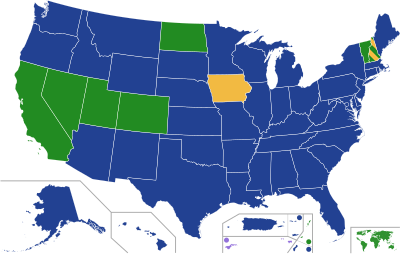
The 2020 Democratic Presidential primaries have been a whirl-wind of events and unprecedent turning of support like we have rarely seen before. The Senator from Vermont, Bernie Sanders, barely lost in a close race to eventual nominee Hillary Clinton, who then lost to Republican Nominee Donald Trump in the general election. This was a crushing defeat for the Vermont Senator who had rallied a tremendous amount of grass roots support and had seemingly been cheated out of a nomination from rules favoring Senator Clinton from the Democratic National Committee. Bernie Sanders seemed determined to not make the same mistakes again in 2020 and was leading the charge for the nomination early out of the gate, by winning  Iowa, New Hampshire, and Nevada. In all of those races, the former Vice President Joe Biden was receiving support in the single digits. That is until the South Carolina Primary was held on February 29th. Biden received a tremendous 48.7% of the vote with the 2nd place Sanders receiving just 19.8%. Following this win we saw a rallying electorate with major candidates dropping out and Biden receiving a huge boost. Pete Buttigieg dropped out and endorsed Biden, as well as Amy Klobuchar and Andrew Yang. The next string of victors for Biden would come during Super Tuesday when he would win a staggering 10 states, to Bernie Sanders 4. This would lead to Michael Bloomberg and Elizabeth Warren dropping out. Bloomberg would then endorse Joe Biden. Finally, on March 10th Biden would then win 5 out of 6 states, surely securing his path to the nomination.


What we witnessed first hand was an example of partisan mobilization in the Democratic party. Walter Veit stated: "economics, psychology, and political science describes the 'bandwagon effect' - or alternatively 'contagion effect' - as a general cultural phenomenon or bias in which the rate at which the spread of ideas, behaviour, and trends more generally, rises with the rate of others adopting the trend.” Many scientists and psychologists have weighed in on why Joe Biden is now winning the nomination. A further trend that is occurring, especially with candidates endorsing Biden is the bandwagon effect. Veit continues to elaborate on this by saying “For Democrats, especially the moderates among them, there was a consolidation problem in deciding who to endorse. In a field with progressives such as Bernie Sanders and Elizabeth Warren, moderate Democrats were scrambling for votes amongst each other. The victory of Joe Biden in the South Carolina Democratic primary sent a signal for all the others to unify behind him. Had this decisive victory gone to any other of the moderate candidates we might be looking at a very different field now. It thus need not be a sign of the quality of Biden's candidacy, but rather an instance of the Bandwagon Effect. An easy analogy suggests itself from the success and failure of restaurants that might be based entirely based on chance, rather than their quality.”


The bandwagon effect and political mobilization of voters was seen in 2016 with Republicans and Trump. At a certain point in the campaign several big name Republican candidates dropped out and endorsed Trump and campaigned for him, name Chris Christie and Ben Carson. This type of bandwagoning is an interesting concept to study and analyze on when candidates decide its time and how they decide who to support. This year, it appeared to be after South Carolina and the candidate was Joe Biden.

Will the coronavirus affect this year’s presidential election?

Will the coronavirus affect this year’s presidential election?

Published March 6, 2020 

The Context:
As the number of Americans infected with the coronavirus has continued to climb – including three new cases in Montgomery County, which is just north of Washington, D.C. – some have speculated that the virus will affect the outcome of the 2020 presidential election. Could it?

The health effects of the coronavirus are much more serious and weighty than its political ramifications. Still, it is an election year, and both Democrats and President Trump have been making some partisan hay out of the virus. It is thus worth at least contemplating how it might influence what happens in November.

An (admittedly brief) search in political science literature did not turn up much about the relationship between viral epidemics and election outcomes. Seth Masket, in an excellent short essay about the Ebola virus and the 2014 midterm elections, cited a few relevant studies. One study, by Christopher Achen and Larry Bartels, found that American voters have sometimes blamed incumbent parties and presidents for “acts of God,” though 1918 Spanish flu pandemic was not one of them.
The Social Science Facts:
This election is very crucial to the electorate and political parties. For many, this is the long waited time voters have been anxiously waiting for, to vote out Trump. Democrats seek to keep the House, gain the Senate and win the White House and for Republicans, keep the Senate, gain back the House and of course keep the impeached Republican President as Commander-in-Chief. One of the things that the electorate has learned since the election of the 45th president is that voting matters. After the nomination of Hillary Clinton and Donald Trump, many people felt like their votes didn't matter and there was no motivation to get people out to vote. The final results of the day after the presidential election in November of 2016 changed everyone's minds. "The collective action problem of moving the electorate for voting, “people don’t have a reason to vote in their minds because they don’t see it makes any difference.  And until they get a sense that their voice matters they’re not going to have a great an incentive to participate.” (Aldrich) The day after the election we saw thousands of people across the country marching against the election of Donald Trump and after Trumps inauguration, the women's march, was one of the largest single-day protest in U.S. history.
The 2018 Midterm elections results were the results of voters going out to cast their ballots because there was that sense of urgency that their votes mattered and they did. Democrats took control of the House of Representatives in 2018.
As we continue moving forward towards the November elections, people continue to have that sense of urgency to vote. It's true we are officially living in a pandemic due to COVID-19 not one state in the Union is free from the virus. But that's not going to stop voters from casting their ballots this November. Voting and COVID-19 actions have been taken into consideration and there are several ways to cast ballots while we live through this pandemic, we are seeing these alternatives during the Democratic primaries already.
We're still eight months away from the elections and a lot can happen one thing that we will witness for sure is will political parties lead the way or will they follow the public opinion of the electorate? (Leeper & Slothuus)

The crisis that led to the 2018 election

Women are more trustworthy and honest than men. This statement may be true or false, but it does not matter; the only thing that matters is how the public perceives women versus men. The perceptions of the electorate, specifically the Democratic party, on the presidency of Donald Trump have led to more women politicians. This transition to more women in politics comes because members of the electorate view Trump's presidency as a crisis for America, and therefore view women as the saving grace of America.

The 2016 election and Donald Trump leading the United States of America are seen as a crisis for at least a portion of the American electorate. Hillary Clinton highlighted this crisis when she said, "our democratic institutions and traditions are under siege.... and right now, our democracy is in crisis." The political elite, such as Hilary Clinton, is not the only one that opines that America is in a crisis but also almost all of the Democratic party and other members of the electorate. Donald Trump winning the election and his subsequent policies while in office have led the Democratic party to perceive the country in a state of distress. The time between the 2016 election and the 2018 election and the results of that election show this crisis.

First, the American electorate showed their distress from 2016 to 2018. During this period, the approval rating of the president among democrats ranged from five to thirteen percent approval. Immediately preceding the 2018 election, the president had a five percent approval rate. In a similar poll, Gallup found that in September of 2018, thirty-seven percent of people did not trust in the executive branch at all, the highest in recorded history. In a third source, Pew shows that during 2018 only eighteen percent of the public trusts the government. These different polls show that there was mistrust in the government, and the country viewed their electorates as flawed. The constituency saw the country in crisis. These perceptions of the government by the public and especially the Democratic party lead to a political uprising in the 2018 elections.

In their article Funk, Hinojosa, and Piscopo analyze past crises and conclude that during those times, the electorate and selectorate have chosen to elect more women. The perceived crises have led to more women in government because of gender stereotypes. These periods of crisis lead to more women in politics because the public does not trust the government and views politicians, as corrupt. This corruption leads to more women because the gender stereotypes of women say that women are more honest and trustworthy. Before the 2018 election forty-four, percent of Americans saw the government as corrupt up eight percentage points from 2016. The perceived corruption in the United States led to more women being elected in 2018 to combat dishonesty.

The conclusions made by funk et al. are relevant to the 2018 election in the United States because the crisis led to a substantial increase in women elected to office across the United States. The electorate saw the problem and reacted as predicted. More than 250 women were on the ballots during the 2018 primary election, and 117 women were elected and sent to congress. The change of more women leaders in that election led to females making up about forty percent of Democrats in congress. The Democrats increased more in their female leadership because they perceived Donald Trump as an undeniable problem; thirty-three percent of voters even used their vote to signal explicit opposition of Trump. Whereas the Republican party did not vote in as many women for various reasons, but one reason could be that they did not view the president as dishonest and corrupt. The Democratic electorate viewed Donald Trump as a threat to democracy and different ideals that they hold dear, and because of that, they elected more women into office to combat the established officials.


Is Jeff Principled or Just a Flake?

In September of 2019, a whistleblower came forth with information that implicated President Donald Trump in a scandal that had potential grounds for impeachment. The Republican Party was already somewhat fractured, the members divided by varying levels of support for their commander in chief. Tensions only grew with this new speculation. 

Republican Senator Jeff Flake of Arizona was a main character in this shocking period of the Trump presidency. Flake had served in the Senate since 2013 and was not a supporter of President Trump early in his presidency. His concerns were heightened as he stated in a 2019 press conference, “Traveling overseas, I witnessed the damage being done to our standing in the world as a result of President Trump’s fondness for authoritarians and his scorn for allies. His hostility toward security alliances and trade agreements had placed our long-term security and our economy at risk”. Flake’s concerns resulted in him resigning from the Senate in 2019. He knew that his own beliefs were at odds with a large faction of the political party that he represented and feared that he would either have to jump on board with things he did not support or risk not being reelected when the time came. While this was not an easy choice, he stood for what he believed and left. He urged his fellow Senators to stand their ground if it came to a potential hearing regarding impeachment, or when it came to supporting President Trump for reelection.

Whether or not one supports President Trump or Senator Flake, or even the Republican Party is not the matter at hand. Senator Flake’s decision to stop representing his political party due to the differences he had with it relates directly to the theory and research of Carsey and Layman (2006). In their 2006 article, they make the claim that for a voter to leave their political party of choice requires that they come to a difference of opinion on an issue that is incredibly salient to them. They also state that if this is the case, for a voter to leave over this issue they also must know where the other party (parties) stand. If they find that they come to a mismatch in this process, voters are faced with the choice to either change their personal ideology to align with that of their party or realign elsewhere. Carsey and Layman acknowledge that it is rare for someone in one party to flip completely to the opposing party. More often than not they simply become less involved, or less vocal of their positions. These hypotheses were tested using panel data spanning 4 years.

Figure 1: Tree diagram illustrating Carsey and Layman's main argument
 
Senator Flake is a prime example of Carsey and Layman’s hypothesis. He was aware of where both major parties fell on issues and began to see how his own party acted in a way that was contrary to his values. These issues were salient enough to him that we saw him step down from a prominent position within his party, and out of the spotlight. While he did not transition to the Democrat Party, Senator Flake has definitely cut several ties with the party he once represented.

Senator Flake serves as a prime example of what happens when one is at odds with their party. This issue is relevant to both Democrats and Republicans. All should strive to align themselves with parties that represent their beliefs and goals. Simply joining a political party and allowing it to dictate one’s decisions is destined to result in a mindless electorate, and in the downfall of our democratic system. While the decision to push back against one’s preferred political party may be difficult in the moment, doing so allows citizens to shape their nation, and to elect those that they believe will best serve.

Three Memes for These Troubled Times


Getting Women in Government: A Never-Ending Struggle


Politics has long been regarded as a male profession. Even as more and more women are working outside of the home and are building successful careers, there are many societal barriers that make it hard for capable and qualified women to obtain leadership positions. This tradition is starting to break down, but not without a struggle from almost every angle.

UN Women cites that only 24.3% of all national parliamentarians were women as of February 2019. As of June 2019, 11 women are serving as Head of State and 12 are serving as Head of Government. As a beacon of light, Rwanda has the highest number of women parliamentarians worldwide, where, women have won 61.3 per cent of seats in the lower house. However, if we look worldwide, there are 27 States in which women account for less than 10 percent of parliamentarians in single or lower houses, as of February 2019, including 3 chambers with no women at all.

These observations can be studied on a smaller scale. The Funk, Hinojosa, and Piscopo article studied women's candidacy and the gendered effects of female nomination in Latin America countries. Their study shows that women are more likely to be elected when there is political discontent. This is because women are stereotyped to be more trusting, which seems to be an advantage, but the glass cliff phenomena needs to be acknowledged as a factor as well. Women like Hilary Clinton and Nancy Pelosi are examples of women in America being asked to lead during a crisis (or the Trump administration). The Funk et al article says, "Conventional wisdom and past research suggest that gender quotas and party ideology are among the most important predictors of women’s nominations.” This shows that even though women are being nominated, they still have barriers to overcome to get there.

History has shown this to be true, but an interesting case study could be made of the 2020 election. Polls show that democratic voters don’t believe that a woman could beat Trump, showing that women are held to a higher standard to men when it comes to leadership and politics. Leanin.org did a study on the 2020 election using data from the Ipsos KnowledgePanel. They found that a majority of voters think it will be more difficult for a woman to win the 2020 presidential election. Around 88% of voters who think this say it’s because “many Americans aren’t ready to elect a woman president” while only 16% say that most Americans are very or extremely ready. However, when asked they, personally, were ready for a female president, 53% said yes. But what contributes to this?

Stereotypes are the main contributor of sexism in any situation. Understanding them is vital to understand what the problem is and how to fix it. There are two main stereotypes described in academic literature. Descriptive gender stereotypes designate what women and men are like. This type promotes negative expectations about a women's performance by creating a perceived “lack of fit” between the attribute’s women are thought to possess and the attributes thought necessary for success in traditionally male positions. Prescriptive gender stereotypes designate what women and men should be like. This second type establishes normative expectations for men's and women's behavior, resulting in the devaluation of women who directly or indirectly violate gender norms. 

Likability effect is a theory based off of stereotypes and is another reason why women have not been elected as often. It is the attribute that most strongly predicts whether a candidate is viewed as presidential and electable. We expect women to be kind and communal and we like them less when they are assertive or forceful. However, men are expected to behave that way so they don’t receive the same pushback. The Leanin survey found that almost half of voters think the men candidates are more presidential and electable. And very few voters see it the other way—less than 15% rate the women candidates higher on these traits.

Lack of fit is another strong reason. Stemming again from stereotypes, lack of fit is when women or men do not fit the mold of their gendered stereotypes and are thus regarded as unfit for the position they seek. Because of “lack of fit”, female candidates are penalized for exhibiting power-seeking desires because they are not seen as holding leadership skills that are attributed to men, as stated in an article by Victoria Brescoll.

A counterpoint might be made that women have not gotten as far in this election because of the Trump Era that we are in. I would argue that it has been the American Era, thus far, to not elect a woman. Just ask the 45 male presidents.

Word Count: 787
Heilman, Madeline E. “Gender Stereotypes and Workplace Bias.” Research in Organizational Behavior 32 (2012): 113–35. https://doi.org/10.1016/j.riob.2012.11.003.
Brescoll, Victoria L., and Tyler Okimoto. “The Price of Power: Power-Seeking and Backlash Against Female Politicians.” PsycEXTRA Dataset, 2010. https://doi.org/10.1037/e506052012-245.
“New Research on Gender and the 2020 Election.” Lean In. Accessed March 17, 2020. https://leanin.org/data-about-gender-bias-and-electability-in-the-2020-election.
Phillips, Amber. “Analysis | How Gender Bias Is Shaping the 2020 Democratic Primary.” The Washington Post. WP Company, May 6, 2019. https://www.washingtonpost.com/politics/2019/05/06/how-gender-bias-is-shaping-democratic-primary/.
“Facts and Figures: Leadership and Political Participation.” UN Women, June 2019. https://www.unwomen.org/en/what-we-do/leadership-and-political-participation/facts-and-figures.


Partisan Mobilization

In past weeks Bernie Sanders has taken lead in the democratic nomination. Many candidates have dropped out one by one leaving him with Presidential candidate Joe Biden; however, Bernie is in the lead. The main question on everyone’s mind is, is it enough to beat President Donald Trump? Brownstein from CNN says that Bernie Sanders believes he can win under the idea of mobilization.
Joseph Gershtenson discusses partisan mobilization and the logic behind the ideology. The mobilization is not necessarily for the parties but for the individual citizens. This is because in a general election to vote for primaries each party wants to vote for the most democratic or most republican leader there is and the best to represent the party. When it comes to the general election most politicans try to be as moderate as possible to gain votes from the other side, because they already have the votes from their own party. This also shows that during the term of a presidency the presidential candidate will not make choices because of their party, necessarily, but they are capable of doing what is right for the people.

The idea behind Gershtenson’s theory is that after a democratic ticket Bernie will have the ability to get the votes required to win the presidential election because of his capabilities. However Brownstein along with many people in the democratic party do not know if Bernie can do it. Bernie, though an independent, has a very hard line ideology in Socialism that is not very partisan similar to Trump in the sense of his hard line politics. Hypothetically making these two unappealing to many Americans with no in between of the two. Brownstein also comments that the democratic party will be doomed as far as winning the 2020 election.
Gershtenson continues on by discussing that declining voter turnout is enhancing social interactions and targeting individuals, which identifies one of many reasons mobilization is necessary. Gershtenson later says that through these strategic changes Democrats and Republicans aim toward educated, wealthier, and older individuals. Both parties are competitive regarding the election period and while democrats reach out to other social and ethnic groups they are not marginally different from their competitors.

This is one area Bernie is doing well in. He approaches and reaches out to many other social groups. Much like Gershtenson explains it is enough and that the main area targets are being aimed at. Brownstein talks about republicans using the same tactics that the democrats do by mobilizing. This is not a benefit to Bernie. Many believe that whoever was to win the democratic ticket would create a space for those who do not agree with President Trump; however, Bernie is not a great person to do this because of his polarizing. Sanders’ only tactic to winning the election may be influencing the swing voters.
All in all Trump and Bernie will have an interesting race against one another if Bernie’s name is on the ticket. However, this does not mean it is a homerun. It is important that as the election goes on each candidate uses partisan mobilization to their advantage. It is their best chance at winning.

Mobilizing Millennials

Millennials have been the source of much debate in the US. It only takes a quick google search to find hundreds of articles that list what industries millennials have “killed.” One Business Insider article was actually titled, “Psychologically scarred millennials are killing countless industries from napkins to Applebee's — here are the businesses they like the least.” The article even prefaced their list with the following sentence: “Here are 19 things millennials are killing.” 
(This is an actual google search I did)

While many articles overdramatize and sensationalize the repercussions of millennial behavior on industries, there is some important truth to it. Millennials do operate differently than previous generations and, although bluntly put, the Business Insider article touched on another point that likely has some truth to it. It is very possible that millennials as a generation are “psychologically scarred.” These are the people that were born in 1980-1994 who were young when 9/11 happened and when the 2008 financial crisis hit. As a generation they have had to adapt to many difficult world events and entered the workforce in a time uncertainty. 


Millennials are now between the ages of 25-39 and, according to Pew Research, make up the majority of the work force—beating out Gen Xers in 2016. While Millennials have become the majority in the labor force, there still is a disconnect in the political arena.  In the last few years there has been some progress with millennial voter turnout, but they still have not caught up to older generations yet.


Regarding the 2020 election, Anthony Cilluffo and Richard Fry of Pew Research said, “Differences in turnout rates again matter when talking about generations and should be kept in mind as election season gets underway. Since older adults are more likely to turn out to vote, it’s possible that older generations will form a larger share of actual voters in 2020 than their share in the electorate.”  Even with the progress of millennial turnout, these older generations are still more likely to have higher percentages of voter turnout. It is likely that 2020 will follow the same pattern of the 2016 presidential election where boomers and older generations cast 49% of the ballots while only accounting for 43% of the eligible voters.


Another point made by Cilluffo and Fry is that millennials and younger generations “differ notably from older generations in their views on key social and political issues.” It is not clear the what effect this will have on the 2020 elections but at the end of the day it will depend on voter turnout. Political scholar Joseph Gershtenson in his 2003 research on political mobilization predicted that parties would need to adapt to changes like this in order to win future elections. He said, “More generally, political parties should be expected to adapt to changes in the electoral environment and the findings here suggest that such adaptation occurs. Parties adapt to changes in the electoral environment because they aim to win elections.”


Historically both the democratic and republican parties have put their effort into mobilizing older, educated, and wealthier citizens to vote. While that has been effective in the past, the parties will need to adapt their voter mobilization strategies to grow voter turnout for younger generations. According to Pew Research, when millennials were combined with the younger generations they actually outvoted boomers and the older generations in 2018. It is likely the 2020 election will see similar outcomes. While older generations might vote at higher percentages, there are still more young voters that parties need to take into account.


Works Cited

'Psychologically scarred' millennials are killing countless industries from napkins to Applebee's — here are the businesses they like the least
https://www.businessinsider.com/millennials-are-killing-list-2017-8

Millennials are the largest generation in the U.S. labor force
https://www.pewresearch.org/fact-tank/2018/04/11/millennials-largest-generation-us-labor-force/

Gen Z, Millennials and Gen X outvoted older generations in 2018 midterms
https://www.pewresearch.org/fact-tank/2019/05/29/gen-z-millennials-and-gen-x-outvoted-older-generations-in-2018-midterms/

Mobilization Strategies of the Democrats and Republicans, 1956-2000
https://learningsuite.byu.edu/plugins/Upload/fileDownload.php?fileId=80d90861-sUu8-RtcA-qdRH-UE4d2847884f 

An early look at the 2020 electorate 
https://www.pewsocialtrends.org/essay/an-early-look-at-the-2020-electorate/