Black voter turnout fell dramatically in the 2016 Presidential election. Why? A common answer is that in 2008 and 2012 Barack Obama was one of the candidates, boosting black turnout because he is black; with no black candidate on the ticket in 2016 black turnout naturally fell. This group identity explanation does seem to make a lot of sense, but in reality, black voter turnout had been on the rise since 1996, increasing from about 54% in that year to 56% in 2000, 60% in 2004, 65% in 2008, and 66.6% in 2012 (see figure below). When black voter turnout fell to 59.6% in 2016, it was the first time it had decreased in twenty years. Why the decrease, after twenty years of increase? Remember, as black voter turnout was increasing before 2008, that was without any black candidate on the presidential ballot. Party mobilization efforts, rather than group identity explanations, can help explain how twenty years of increases in voting would suddenly decrease.
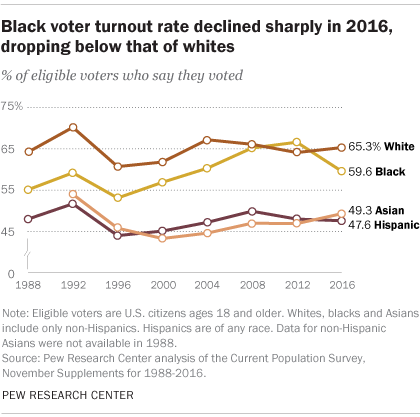
One basic function of political parties is to mobilize the electorate to vote for the party’s candidates in a given race. They accomplish this through formal and semi-formal get-out-the-vote efforts including meetings, contact campaigns (door-to-door, flyers, posters, emails) and social media outreach efforts. Often candidates bear the brunt of the cost for these efforts, but the political party provides the important ideological support in endorsing and explicitly supporting these activities. Political scientists have traditionally expressed skepticism as to whether these get-out-the-vote efforts really make much of a difference, and studies have confirmed that these efforts generally influence a tiny number of voters (class discussion). Nonetheless, politicians and campaigns continue to spend great amounts of time and resources on these efforts, perhaps because of psychological reasons (not wanting to be idle while waiting for election day) and with the recognition that elections are sometimes decided by just a handful of voters (class discussion).
In their paper Winning the Race, Black Voter Turnout in the 2008 Presidential Election, Philpot et al. studied the high levels of black voter participation in the election and found that attitudinal reasons for the increase in black voter turnout—group identity with the candidate—actually played a very limited role in the increase in turnout and may have had no role at all. Their experiment and regression analysis confirmed that mobilization efforts by the Obama campaign and the Democratic party were largely responsible for the increase. The black community was specifically targeted by the Obama campaign in their get-out-the-vote efforts and the polls showed that the effort worked. Or at least, it didn’t decrease black voter turnout. The trend of increasing black voter turnout since 1996 continued in 2008 and 2012.
In light of this, the drop-off in black voter turnout in 2016 is better understood as a mobilization problem instead of a ‘not-having-a-black-candidate’ problem. Secretary Clinton’s mobilization efforts did not reach black voters the same way that Obama’s had. This change could explain why black voter turnout dropped off in 2016—not because Clinton was white, but because her get-out-the-vote efforts were focused less intensely on black voters than Obama’s get-out-the-vote efforts.

No comments:
Post a Comment