Blog Post #2 - Spencer Manning
Overview of Issue
 |
| Figure 1 |
According to Pew Research Center (PRC), 52% of registered female American voters lean democrat, giving credence to the notion that political parties appeal to the demographics in their voter constituency (PRC - Party Affiliation). However, and more importantly, recent social justice affairs and the continued coronavirus pandemic draw significant attention to the volatility, divisiveness, and distrust in the current United States political landscape and government (Figure 2); accordingly, many suggest a female VP in the White House may be the perfect remedy to the nation's challenges.
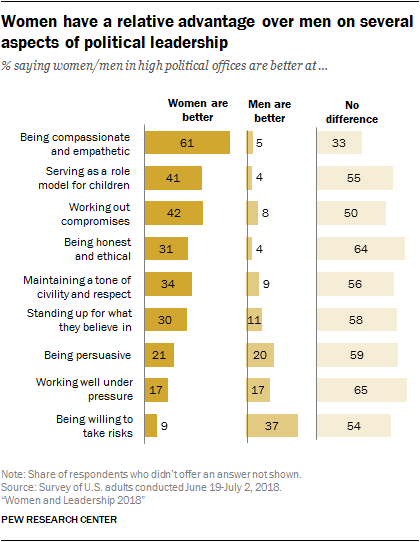
Based on PRC data, women currently in/or seeking political positions have a number of distinct gender advantages over their male counterparts, especially in regard to certain character traits which alleviate some challenges of the political climate. As such, these advantages are based on polling data from the general public, they include: a 61% to 5% advantage over men in compassion and empathy; a 42% to 8% advantage over men wherein they can work out differences through compromise; a 31% to 4% advantage over men in honesty and ethical posture; a 34% to 9% advantage over men with the ability to maintain a tone of civility and respect (PRC - Women in Leadership/ Figure 1).
 |
| Figure 2 |
Political Theory
Based on our reading of the article Women to the Rescue: The Gendered Effects of Public Discontent on Legislative Nominations in Latin America by Kendall D. Funk, Magda Hinojosa, and Jennifer M. Piscopo seek to understand the salience of the relationship between the increase of political distrust and perceived corruption with "gender stereotypes that regard women as more trustworthy and honest" political representatives. Accordingly, Funk, Hinojosa, and Piscopo make two broad hypotheses to test this causal relationship. First, they hypothesize that "women's nominations will increase as the public becomes more distrustful of the legislature" and government as a whole. Second, they hypothesize that "women’s nominations increase as the public perceives corruption to be commonplace". To test these two hypotheses, they took women's nomination data from the Inter-American Development Bank’s project on Gender and
Political Parties in Latin America survey, which used a two-wave survey data set of 100 political parties in 18 Latin American countries; in addition, they took trust/mistrust data from AmericasBarometer by the Latin American Public Opinion Project. Following thorough research of multivariate analyses, Funk, Hinojosa, and Piscopo conclude that "gender stereotypes of women as more honest,
more trustworthy, and less associated with the traditional
political elite can advantage women ...when
the public distrusts politicians or perceives high amounts of
political corruption". Thus, if a countries' public feels high levels of distrust, corruption, or even disdain for their collective government, it may be in the interest of political parties to nominate female candidates for office (Funk, Hinojosa, and Piscopo).
So What?
Upon the reflection of the recent social justice and Covid-19 events (which have propagated strong negative political emotions among the public), as well as our understanding of the causal relationship between political distrust with a higher likelihood of female representation in political parties, we come to understand that Joe Biden's upcoming announcement of a female VP candidate will be a strong appeal to voters because of the positive attributes of women's gender stereotypes. Moreover, a Democrat/Joe Biden nomination of a female VP candidate for the 2020 election will be crucial to gathering the vote of a number of different groups, including: (female) independents, fringe voters, (female) Democrats, and others who see female representatives as particularly likable and trustworthy amid these times of (supposed) corruption, polarization and distrust. We also recently learned about one of the large roles of political parties (which is to nominate candidates best positioned to win elections); therefore, we should clearly see that Democrat leadership is employing a strategy to best position Joe Biden to win the 2020 presidency. In conclusion, while gender stereotypes certainly can benefit both male and female politicians, a female VP may be seen as better equipped to unify, heal, and bring ethical representation to a distrustful political environment.
References:
Funk, Kendall D., Magda Hinojosa, and Jennifer M. Piscopo. “Women to the Rescue: The Gendered Effects of Public Discontent on Legislative Nominations in Latin America.” Party Politics, 2019, 135406881985661. https://doi.org/10.1177/1354068819856614.

No comments:
Post a Comment