Overview of Current Event
During the previous three months, the deaths of Ahmaud Arbery and Geroge Floyd have re-highlighted what some consider, the prevalent problem of systemic racism and equality towards Black Americans in the United States. Per Figure 1, the use of #BlackLivesMatter on the Twitter platform reached an all-time high, which substantiates that a significant portion of the public perceives racial and equality issues to (1) exist, and (2) hinder Blacks and other racial minority groups from obtaining appropriate levels of inalienable rights and opportunity. Moreover, the salience of race relations and associated discussions of equality (for all U.S. citizens - regardless of age, race, gender, and sexual orientation) has increased substantially across all media and news outlets. In addition, these issues have become largely politicized, stemming from their heavy coverage during political campaigns and debates preceding the 2020 general election. For any change which directly affects the rights and freedoms of U.S. citizens to ensue, the mechanism by which adjustments are made is through legislation and collective action of both (1) the government, and on a broader scale, (2) the public. Therefore, these recent events, coupled with the urgency of the upcoming November general election, have initiated political parties to re-affirm their subjective attitudes and policy platforms to address such dilemmas. Fortunately for the Democrat Party, most racial minority groups largely identify as Democrats; as such, the party may mobilize a significant portion of their 2020 voter constituency to rally around race and equality problems (Figure 2).
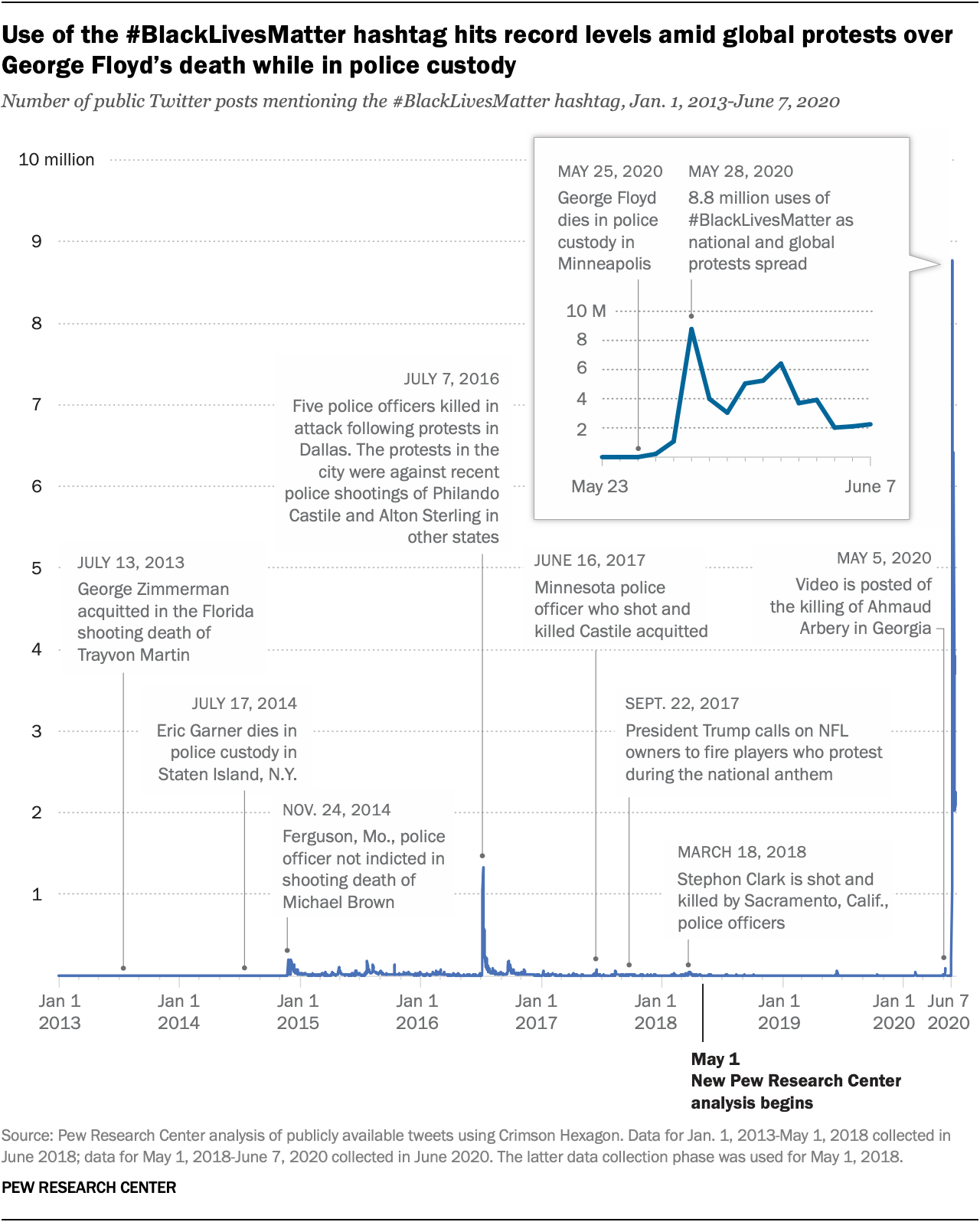 |
| Figure 1 |
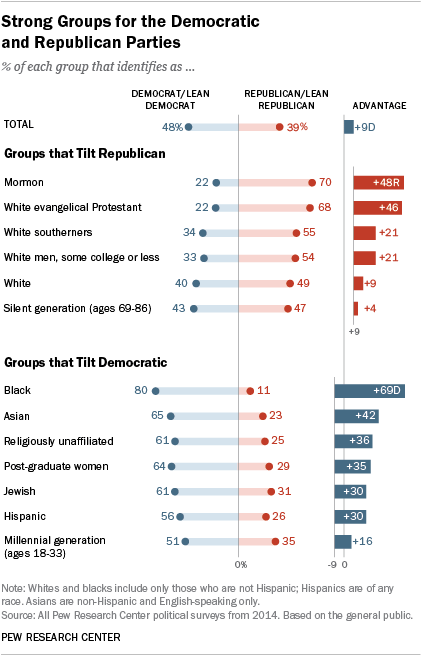 |
| Figure 2 |
In a 2017 publication, Leonie Huddy and Alexa Bankert introduce a social identity theory of partisanship: the expressive approach. The expressive approach is stated as the "enduring identity strengthened by social affiliations to gender, religious, or ethnic and racial groups". Meanwhile, the cognitive underpinnings of this expressive approach are confirmed by the foundational social categorization theory, where individuals in groups are aligned and associated with certain "group stereotypes". Huddy and Bankert argue that as individuals acknowledge and internalize their social group assimilations and stereotypes, they will then naturally generate more social bias and a greater political proclivity to "increase their party’s chances of electoral victory and boost its status". Meanwhile, in-group bias and associations are most strong when certain events propagate strong negative and positive emotions in individuals. While the causal relationship between the internalization of social identity and political action is clear, the theory is not standard for all individuals. Accordingly, some individuals may simply not care for politics, while others do not connect political party identification and action with the expressive approach of social identity and in-group bias. On the contrary, the instrumental approach (where individuals make rational political choices based on a number of variables: party and candidate performance, policy platform, presidential approval, and economic performance) provides an alternative for individuals to make political choices not fully motivated by group identity theories and stereotypes. Finally, Huddy and Bankert suggest that a candidate-centered electoral system (as found in the United States) allows party-elites, political candidates, and political parties to disproportionately control the public perception of social stereotypes and their in-group bias, pertaining to party affiliation. As a result, because political parties (and their constituency) seek to win elections and ensure party success, they will mobilize their electorate by helping individuals make connections between their social identities and associated stereotypical political action and identifications, particularly in election years.
Democrat Mobilization of the Minority Vote
Upon the reflection of recent racial and social justice events and protests, (which have propagated strong negative emotions in individuals with pre-determined social in-group minority bias) as well as our understanding of the expressive approach to social identity, the connection is clearly understood that the Democrat party has mobilized, and will continue to mobilize their staunch minority constituency to campaign for social justice and equality ahead of the 2020 General Election, particularly among the Black community. Whether this method of electoral mobilization is ethical or effective is neither here nor there, it certainly highlights the manner in which political parties use social in-group identifications to mobilize their specific electoral base. Huddy and Bankert also suggest that "the electoral effect of group loyalties is most pronounced among African Americans who identify with both the Democratic Party and their racial group". As an example, Lebron James, a prominent Black American, social justice activist, and strong supporter of the Democrat party, is fervently attempting to mobilize minority constituencies to make changes in the upcoming November election (New York Times Reference). From this perspective, prototypical group members and party-elites (Barack Obama and LeBron James) help to establish the social in-group connection with strong partisan tendencies and actions.
References:

No comments:
Post a Comment